AI VOICE DICTATION FOR WINDOWS
Turn your voice into accurate, punctuated text in Word, Outlook, web forms, and any Windows application. No voice training required.
No credit card required. Installs in 2 minutes. Windows 10/11.
"I built Speech Recognition Cloud after 28 years of deploying speech technology for tens of thousands of professionals. I have watched what works, what frustrates people, and what they actually need. Legacy dictation systems are overpriced, overcomplicated, and overdue for replacement. This product is the answer for most users."
Speech Recognition Cloud adapts to your profession. Choose your field to see how it fits your workflow.

Free 30-day Medical Ultra trial. Specialised vocabulary, ultra accuracy, works with any EMR.
Learn more →

Voice dictation for nurses, radiologists, allied health, and healthcare administration.
Learn more →

Draft contracts, briefs, and case notes by voice. Confidentiality controls built in.
Learn more →

Emails, reports, and documentation at the speed of speech.
Learn more →

Secure dictation for policy, correspondence, and procurement documentation.
Learn more →

Essays, notes, and assignments faster. Affordable plans for students.
Learn more →

Lesson plans, reports, and correspondence without the typing.
Learn more →

Transcribe interviews, draft articles, and file stories faster.
Learn more →

Reduce keyboard use. An alternative input method for anyone with motor limitations.
Learn more →Dictate into any Windows application at your cursor. Word, Outlook, Chrome, EMRs, web forms. Anywhere you can type.
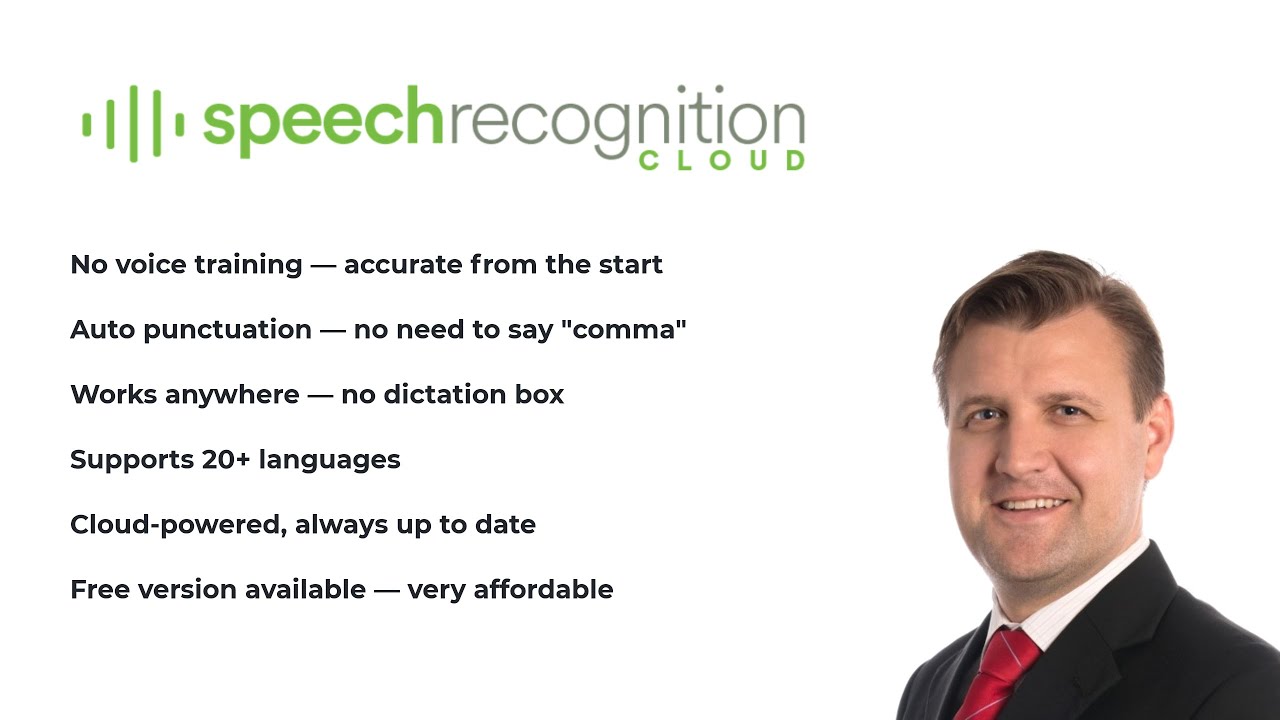
Install and start dictating immediately. No voice profiles, no calibration, no setup wizards.
Speak naturally. The AI adds punctuation, capitalisation, and formatting automatically.
Add specialised terms, names, and jargon. The system learns your terminology.
20+ voice commands for productivity. Auto-insert text blocks with templates.
Broad language support across Free, Personal, and Professional plans. Medical tier is English only.
Enhanced accuracy processing for Professional and Medical tiers. When precision matters most.
Audio is processed and not stored. Your data is never used for training. You stay in control.
Cloud AI handles accent variation well. Designed for real-world environments and diverse speakers.
Privacy is not a feature. It is how the product works.
Audio is processed in the cloud and immediately discarded after transcription
Transcribed text is delivered to your cursor and not stored on our servers
Your data is never used to train AI models
All connections are encrypted in transit
No audio recordings are saved at any point
Medical tier includes restricted AI modes for additional privacy
Verifying factual claims about the preservation of the art or the tools used by early humans. Theoretical Perspectives in the Reading
IELTS often tests whether a discovery was the first of its kind or just one of many.
Paleolithic cave art refers to drawings, etchings, and paintings found on cave walls dating back to the Upper Paleolithic period (roughly 40,000 to 10,000 years ago). These artworks are primarily located in Europe, with famous sites including Lascaux in France and Altamira in Spain. Key Characteristics paleolithic cave art ielts reading answers
To succeed in this reading, familiarize yourself with these high-level terms: Art on cave walls or large stone blocks. Pigment: Natural coloring matter used for paint. Superimposition: One image painted over another.
The Paleolithic cave art IELTS reading passage is a frequent feature in the Academic Reading module, often challenging students with its blend of archaeological theory and descriptive vocabulary. Understanding the nuances of this topic is essential for achieving a high band score. Overview of Paleolithic Cave Art Verifying factual claims about the preservation of the
The belief that drawing animals would ensure a successful hunt.
A person who studies human history through sites and artifacts. Monochrome: Paintings done in a single color. Tips for Finding the Correct Answers These artworks are primarily located in Europe, with
The IELTS passage usually explores why these paintings were created. Mastering these theories helps in navigating the "Matching Features" section:
Filling in gaps of a text summarizing a specific theory (e.g., the "Hunting Magic" theory).
Identifying which paragraph contains specific details about dating techniques or discovery stories.
Start free, upgrade when you need more.
20 min/month. For students and occasional use.
Affordable unlimited dictation for study, work, and personal productivity.
For professionals who demand accuracy, speed, and advanced features.
Specialised for healthcare with medical vocabulary and ultra-high accuracy.
Pricing accurate at time of publication. Prices in USD and will convert to your local currency at checkout. Cancel anytime.
Verifying factual claims about the preservation of the art or the tools used by early humans. Theoretical Perspectives in the Reading
IELTS often tests whether a discovery was the first of its kind or just one of many.
Paleolithic cave art refers to drawings, etchings, and paintings found on cave walls dating back to the Upper Paleolithic period (roughly 40,000 to 10,000 years ago). These artworks are primarily located in Europe, with famous sites including Lascaux in France and Altamira in Spain. Key Characteristics
To succeed in this reading, familiarize yourself with these high-level terms: Art on cave walls or large stone blocks. Pigment: Natural coloring matter used for paint. Superimposition: One image painted over another.
The Paleolithic cave art IELTS reading passage is a frequent feature in the Academic Reading module, often challenging students with its blend of archaeological theory and descriptive vocabulary. Understanding the nuances of this topic is essential for achieving a high band score. Overview of Paleolithic Cave Art
The belief that drawing animals would ensure a successful hunt.
A person who studies human history through sites and artifacts. Monochrome: Paintings done in a single color. Tips for Finding the Correct Answers
The IELTS passage usually explores why these paintings were created. Mastering these theories helps in navigating the "Matching Features" section:
Filling in gaps of a text summarizing a specific theory (e.g., the "Hunting Magic" theory).
Identifying which paragraph contains specific details about dating techniques or discovery stories.